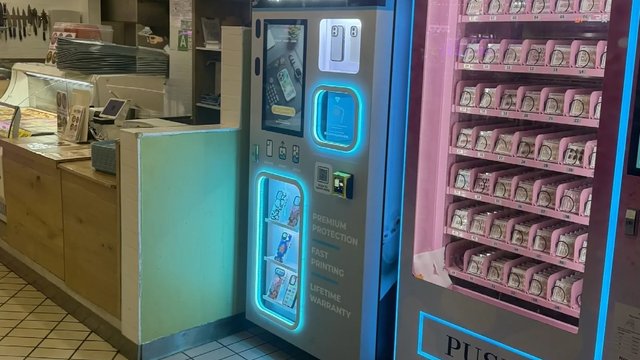
How to Get Your Kiosks into National Retail Chains
Three documented paths to place kiosks in national retail chains, and what to walk in with.

I'm the COO of GOBEAR. We help entrepreneurs, mall operators, 3C mobile stores, event venues, and campus retailers tap into high-margin, low-maintenance vending models.
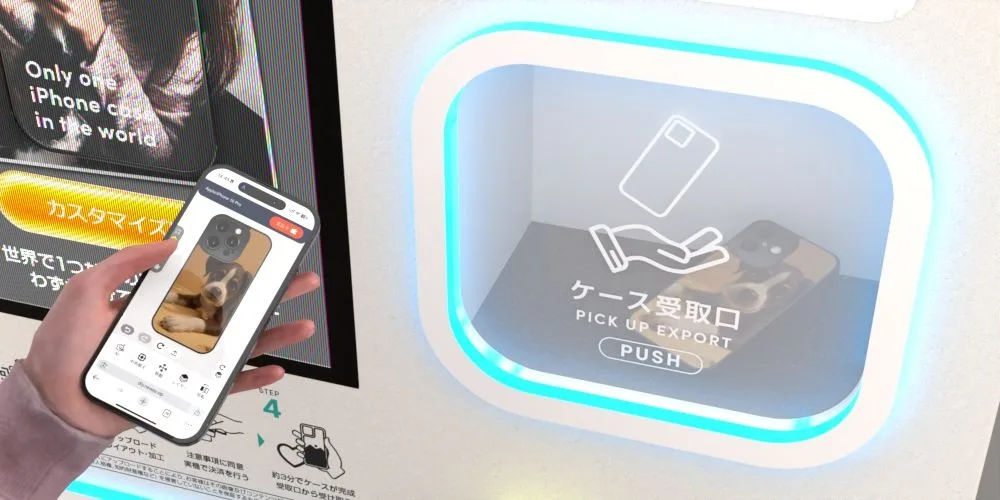
In June 2025, a new brand of custom phone case kiosks appeared across Japan; not as a pilot in one city, but as a nationwide launch. Within about a year, MyCaseLabo stood at 97 machines across 25+ prefectures, printing MagSafe-ready TPU cases for iPhone and Google Pixel from ¥2,980 in Don Quijote, Bic Camera and EDION stores, with a flagship inside Haneda Airport Terminal 3.
GOBEAR supplies the phone case vending hardware featured in this deployment.
The sections below draw on our MyCaseLabo case study to examine the company behind the brand, its retail placements and product offer. They distinguish published deployment details from practical considerations for operators planning their own kiosk network.
If you only have two minutes, here is the short version:
The count: 97 machines across 25+ prefectures within about a year of the June 2025 nationwide launch.
The company behind it: Global Connexion Co., Ltd., a Saitama group established in 2009 with 27 staff and ¥3.06B FY2023 revenue across vending, IoT, telecom and retail.
The dress rehearsal: sister brand FilmLabo launched first (August 2024) and ran screen-protector kiosks to 86 machines; the group validated the unattended format before adding cases.
The placements: national retail chains (Don Quijote, Bic Camera, EDION) plus the Haneda T3 airport flagship, operated in partnership with Vision Inc.
The density: Greater Tokyo holds 41 machines (Tokyo 18, Chiba 9, Kanagawa 7, Saitama 7), with Osaka 7 and Aichi 5 next.
The product: TPU cases, MagSafe-ready as standard, iPhone and Google Pixel, printed in about 3 minutes with AI photo editing, from ¥2,980 (~$20).
MyCaseLabo is the custom-case brand of Global Connexion Co., Ltd., headquartered in Wako, Saitama with an office in Ikebukuro, Tokyo. The group was established in 2009 (sixteen years before this brand launched) and today runs 27 staff with ¥3.06B FY2023 revenue spread across four lines: vending, IoT, telecom and retail. (That revenue figure is the group's, not the kiosk brand's; MyCaseLabo's own machine-level numbers are not published.)
That distinction matters for reading the story. A nationwide launch in month one is reckless for a founder and routine for a sixteen-year operator that already understands machine placement, servicing, cashless payments and the Japanese retail market. MyCaseLabo could start at scale because the company behind it had already spent years earning the right to.
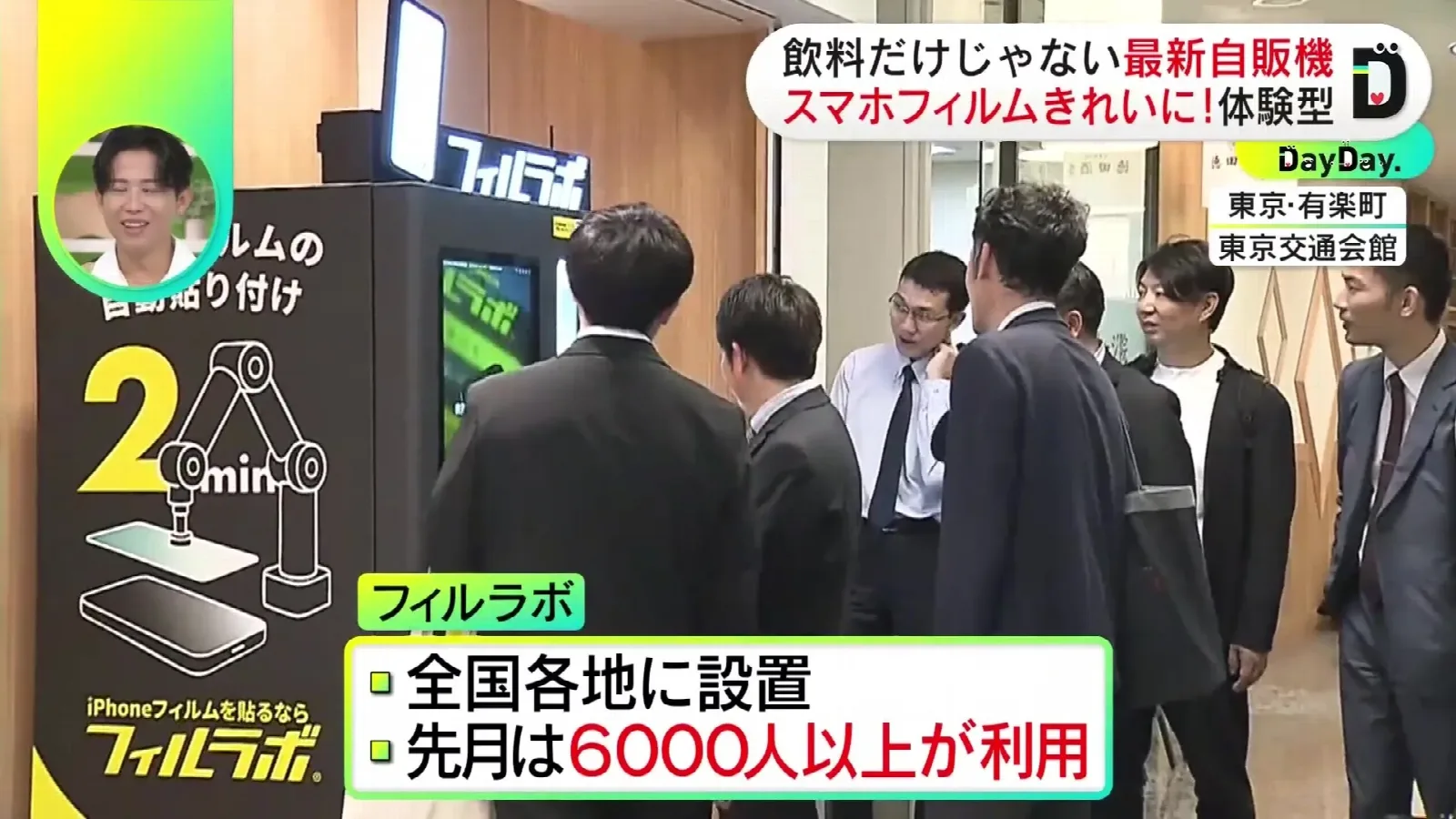
The hidden sequence here is the sister brand. Ten months before MyCaseLabo launched, Global Connexion put FilmLabo into the market; Japan's first fully-automatic iPhone screen-protector vending machine, started in August 2024. FilmLabo grew to 86 machines across 24+ prefectures by July 2026, placed in Kansai Airport T2, Tokyo Metro stations and Don Quijote, EDION, Joshin and AEON stores, and picked up mainstream attention along the way: a feature on TV Tokyo's WBS and a viral SNS moment.
Our reading of the sequence: the group used the film product to validate the hard parts of unattended retail (placement partnerships, restock logistics, machine servicing, media traction) and then brought the case brand to market with those systems already running. The lesson transfers even if the scale doesn't: prove the format on one product before you scale the brand on another.
The placement list explains the speed better than any growth tactic. MyCaseLabo machines sit inside Don Quijote, Bic Camera and EDION (three national retail chains) and the case study lists "venue placement partnerships" as a formal service line of the operation. One chain negotiation produced many locations at once; the brand never had to win floor space store by store.
This is the same pattern we saw across the operator group in our guide to getting kiosks into national retail chains, and the chain fit is visible here: electronics chains (Bic Camera, EDION) put the kiosk beside the phones it prints for, while the variety-retail footfall of Don Quijote monetizes novelty. When a single partner conversation can open dozens of doors, 97 machines in a year stops being surprising.
At the top of the network sits Haneda Airport Terminal 3; MyCaseLabo's flagship, operated in partnership with Vision Inc. (Global WiFi), placed in the international terminal where travelers pick up and return pocket WiFi units. It is the highest-visibility machine in the fleet, and the partnership structure that got it there is the template for entering high-barrier venues: ride the location relationship of an established airport player rather than bidding solo. We broke down that play, and the airport economics around it, in our three-airport comparison.
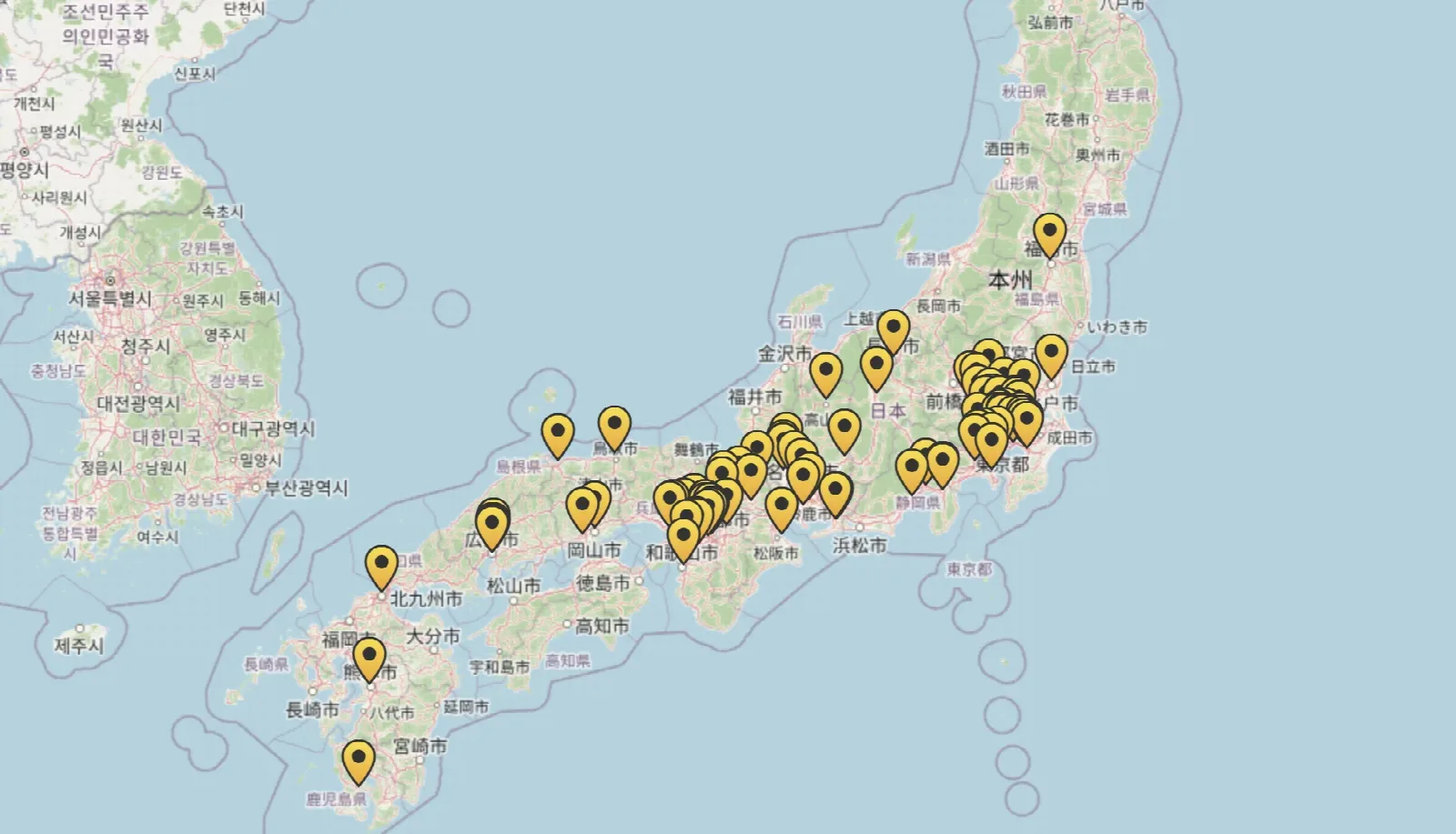
The prefecture distribution is the quiet strategy. Tokyo holds 18 machines; Chiba 9; Kanagawa 7; Saitama 7; that is 41 of the 97 in Greater Tokyo alone. Osaka holds 7 and Aichi 5, with the rest spread across the remaining prefectures to a footprint of 25+.
Two things follow from that map. Operationally, density is what makes a 1–2 week restock cadence and a lean service routine survivable; clustered machines share routes, staff and spare parts. Commercially, concentrated visibility in the biggest metro builds the brand faster than scattered national coverage would.
It is the same lesson the wider operator group shows: between MyCaseLabo and FilmLabo, one group runs 183 kiosks in Japan; proof that demand supports city-level density, not just one machine per town. The 3/8/50-machine scaling stories cover how other operators climbed the same ladder.
The product spec reads as a set of deliberate premium choices. The cases are MagSafe-ready as standard (not as an upsell tier) which positions the whole brand at the top of the price ladder from the first tap; we analyzed that strategy choice in our MagSafe and Qi2 business case. Coverage runs to Google Pixel alongside iPhone, broader than an Apple-only catalog. Printing takes about 3 minutes with AI photo editing on the design screen, and the from-price is ¥2,980; roughly $20, the price point that anchors both the Japanese and U.S. markets in our global benchmark.
None of that is exotic technology. It is a coherent set of choices: premium-standard instead of premium-optional, broad flagship coverage, an engaging design experience, and a price that matches the top of the global band.
An honest close, because the headline number invites copycats. What we know: an operating group with sixteen years of history, a sister brand that had already proven the format, formalized chain partnerships, an airport flagship through a partner, metro-first density, and a premium-standard product. What is not published: MyCaseLabo's per-machine revenue, or what the chain agreements cost.
A buyer can use the example to frame practical questions: which sites are confirmed, how will they be serviced, which phone models need stocking, and what results would justify expansion? The purchase quantity and pricing should follow those answers rather than a target copied from another operator.
The takeaway for a buyer is not to copy this geography but the discipline: the machines were the easy part. A GOBEAR kiosk prints in about three minutes with AI photo editing, covers iPhone and Google Pixel out of the box, and reports to a remote dashboard, so the operator’s energy went to partnerships, not hardware.
97 custom phone case kiosks across 25+ Japanese prefectures, reached within about a year of the June 2025 nationwide launch. Greater Tokyo holds 41 of them (Tokyo 18, Chiba 9, Kanagawa 7, Saitama 7), with Osaka 7 and Aichi 5 next.
Global Connexion Co., Ltd., a group headquartered in Wako, Saitama and established in 2009, with 27 staff and ¥3.06B FY2023 revenue across vending, IoT, telecom and retail. The same group also runs FilmLabo, the screen-protector kiosk brand.
From ¥2,980 (about $20), for TPU custom cases that are MagSafe-ready as standard, covering iPhone and Google Pixel, printed in about 3 minutes with AI photo editing available on the design screen.
Inside three national retail chains (Don Quijote, Bic Camera and EDION) plus the flagship at Haneda Airport Terminal 3, operated in partnership with Vision Inc. Tokyo is the densest prefecture with 18 machines.
The reported ingredients transfer: validate the kiosk format first, convert chain partnerships into multi-location deals, concentrate machines in metro clusters for serviceable routes, and standardize a premium product. What doesn't transfer by checkbook is the sixteen years of retail relationships behind the nationwide launch day.
Running the numbers for your own market? Tell us your target cities and chain list, and we will model demand, pricing and rollout sequence; the same analysis behind the 10 case studies on this site.
Share your business vision with us. Our automated retail experts will craft a tailored strategy and a comprehensive profitability report to unlock your next revenue stream.