
MyCaseLabo: 97 Kiosks in One Year
How MyCaseLabo launched nationwide in June 2025 and reached 97 kiosks in about a year.

I'm the COO of GOBEAR. We help entrepreneurs, mall operators, 3C mobile stores, event venues, and campus retailers tap into high-margin, low-maintenance vending models.
One negotiation with a retail chain beats fifty site-by-site deals. In our operator group, a single chain signature has produced 20+ locations; and MyCaseLabo reached 97 machines across 25+ Japanese prefectures in about a year largely by partnering with Don Quijote, Bic Camera and EDION instead of negotiating shop by shop. In the United States, Balaji Brands' Custom Case Kiosk signed Boost Mobile and SCHEELS and reached 60 kiosks across 25 states within a year of launching.
The kiosk platform is built by GOBEAR.
But the honest story of how those chains got signed is less "great pitch deck" and more "relationships plus proof". This article covers what the chains actually get, the prerequisite nobody advertises, the three entry paths the case studies document, and what to prepare before you walk into a chain's head office. Every operator claim comes from the case studies.
If you only have two minutes, here is the short version:
Why chains: one signature has produced 20+ locations in this operator group; MyCaseLabo's 97-kiosk network was built on national chains within about a year.
What the chain gets: unstaffed revenue per square meter (a K77 needs an 820 × 930 mm footprint), a typical 15–25% venue share band, and an upsell that matches the shopper's mission.
The honest prerequisite: both chain-runners entered through existing corporate relationships; Balaji's parent (est. 2006) already had 20,000+ U.S. retail doors; MyCaseLabo's parent group has operated in vending, IoT, telecom and retail since 2009.
Paths for newcomers: trade-show launches (CES, Bowl Expo), media validation (FilmLabo on TV Tokyo's WBS), and the placement-record ladder (CASED from city malls to an airport).
The pitch artifact that works: the machine itself, printing real cases on the spot in front of qualified buyers.
Chain buyers do not buy machines; they buy floor performance. Four value lines appear in this operator group:
Space and operating responsibilities. A phone case kiosk such as K77 occupies an 820 × 930 mm footprint, plugs into a standard circuit, and needs no chain staff; restocking every 1–2 weeks is the operator's job, managed through remote dashboards with OTA updates. The venue's return is the reported 15–25% revenue-share band, or fixed rent, with zero labor attached.
Relevance to the shopper's mission. This is the strongest pitch. A Boost Mobile customer is standing in the store specifically because they just got (or is about to get) a new phone. A machine that prints a custom MagSafe case for that exact model in under five minutes is the most relevant upsell in the building; Balaji's carrier partnership plugged its kiosks directly into the phone-upgrade cycle.
Newness and experience. Retail chains compete on differentiation, and a machine that prints a personalized case in minutes is both. Custom Case Kiosk picked up Best New Product at the 2026 International Bowl Expo; exactly the kind of credential a chain's innovation team can attach to a pilot.
Zero operational burden. Remote monitoring, over-the-air updates, operator-handled restocking: the machine asks the chain for floor space and power, and nothing else. That asymmetry is the quiet reason chains say yes.
Here is what the case studies show but the success stories rarely mention. The two fastest chain-rollouts in our group did not cold-pitch anyone.
Balaji Brands of Chino, California was established in 2006 and was already present in 20,000+ U.S. retail doors before it launched Custom Case Kiosk at CES in January 2026. The 60-kiosk sprint across 25 states in one year ran on nineteen years of retail relationships; the full story is in our Balaji CES narrative.
MyCaseLabo is the brand of Global Connexion Co., Ltd., a group founded in 2009 with ¥3.06B FY2023 revenue across vending, IoT, telecom and retail; the Don Quijote, Bic Camera and EDION placements were signed by a company those chains already knew, with "venue placement partnerships" listed as a formal service.
Existing relationships can help secure an introduction, but new operators can also approach relevant commercial teams directly. A focused proposal should explain the customer offer, operating responsibilities and a manageable pilot, supported by verifiable equipment and deployment information.
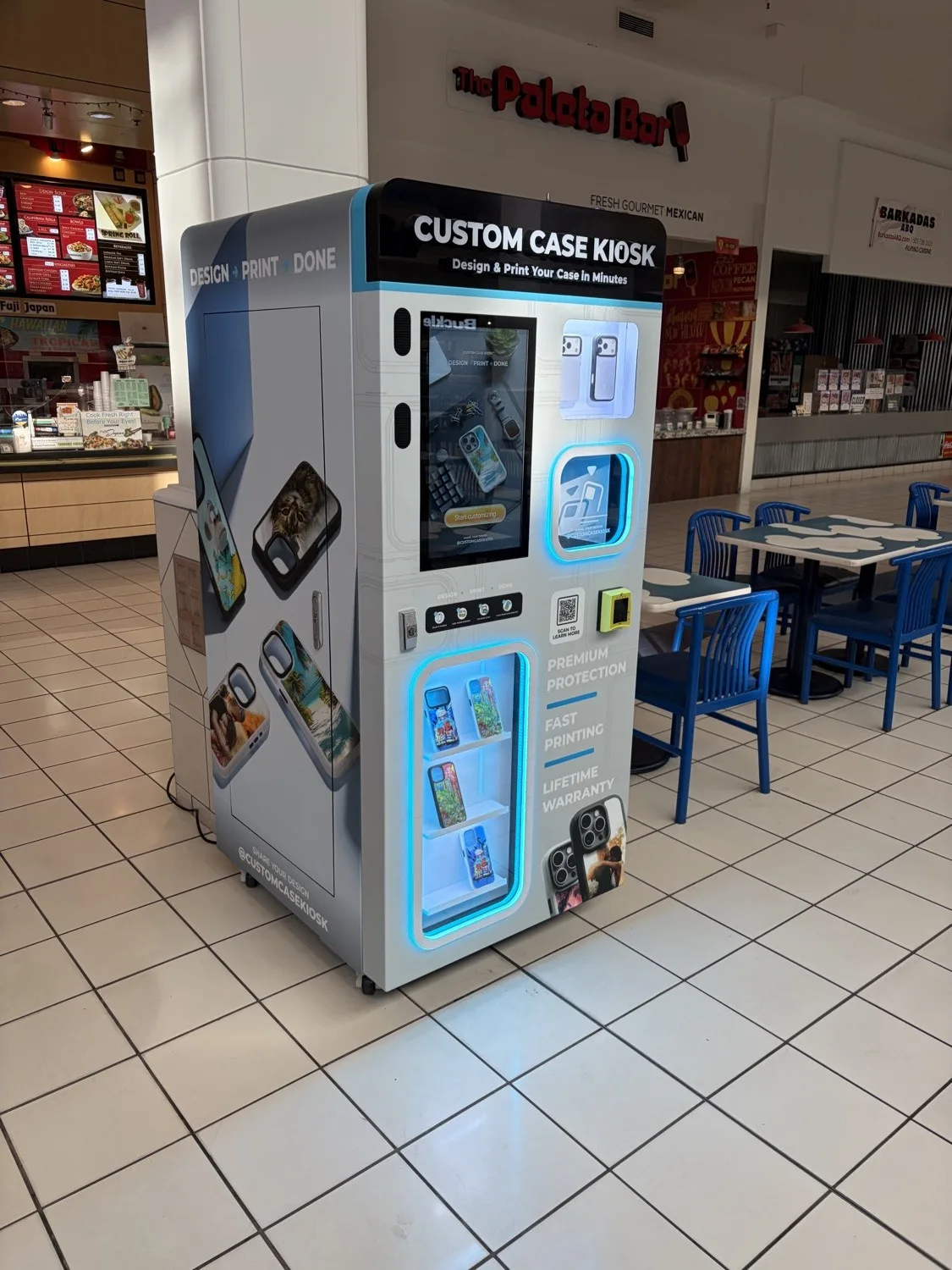
Balaji unveiled Custom Case Kiosk at CES in January 2026; the one room where retail innovation scouts, carriers and franchise buyers are paid to be. Within a year: 60 kiosks across 25 states, from Koreatown LA to SCHEELS Johnstown CO, Dallas TX, El Paso TX and Fargo ND, with six more states coming. The follow-on award at the International Bowl Expo 2026 kept the machine in front of venue operators. Trade shows compress the relationship-building that otherwise takes years; our own exhibition schedule lists where these machines can be seen running.
FilmLabo was featured on TV Tokyo's WBS and became a viral SNS hit; and sits today in Don Quijote, EDION, Joshin and AEON locations alongside Kansai Airport T2 and Tokyo Metro stations. The mechanism is simple: a chain buyer's career risk drops when the product is already famous in their market. Media coverage is not decoration; it is risk transfer.
CASED, a Malaysian lifestyle-tech startup, built the ladder version: nine flagship Klang Valley malls first, then local media coverage (SAYS and others), then klia2 airport. Each placement became collateral for the next. If you cannot sign a national chain today, sign the best independent venues in your city, document everything, and let the record make the introduction.
Whether your meeting comes via a trade show, a feature segment or a placement record, the kit is the same:
A live demo, or footage of real prints. Our reading of the Balaji playbook: the machine printing real MagSafe and Qi2 cases on the spot, in 3–5 minutes, in front of qualified buyers is the pitch; it closes the conversation by itself. Anything you bring that is not the machine should exist to get the machine into the room.
Named case studies. Ten reported deployments across 8 countries exist on this site; use them, including the chains already hosting these machines.
Unit economics the chain can verify: street prices in comparable markets, the 15–25% venue-share band, restock cadence, and who does what.
The fleet-management story: remote dashboard, OTA updates, restock schedule, service response. Chains renew with operators who make their facilities team forget the machine exists.
The compliance pack: certifications for the market, insurance, electrical specs. The chain's facility team will ask; answering before they do is part of the pitch.
Site-by-site negotiation does not scale; chain deals do. What standardizes in a chain agreement, based on how these networks operate:
One footprint, replicated: power, dimensions, safety and branding rules are settled once, then copied across locations.
One commercial structure: the revenue share (15–25% of gross sales is the reported band) or fixed rent, invoiced chain-level rather than store-by-store.
One service standard: restock windows, uptime commitments and escalation paths that hold across every location, backed by remote monitoring.
And choose chains where the machine is relevant to the shopper's mission; that is the reported pattern: electronics chains (Bic Camera, EDION, Joshin) put the kiosk beside the phones; carrier stores (Boost Mobile) attach it to the upgrade cycle; variety retailers (Don Quijote) monetize novelty footfall; destination retailers (SCHEELS) add an attraction. A chain whose shoppers never think about their phones is a chain that will churn you at renewal.
The chain relationship starts, not ends, at signing. The Balaji fleet runs on a remote dashboard with OTA updates (that is what makes 60 locations across 25 states operable at all) with restocking every 1–2 weeks as the reported cadence, the same pattern behind the 3/8/50-machine scaling stories. Uptime is the renewal argument: every dark machine in a partner store is visible to the chain that invited it, and multi-state sprawl from California to Puerto Rico and North Dakota turns logistics planning into a competitive skill of its own.
The machine is what makes the pitch work. An 820 × 930 mm GOBEAR kiosk plugs into a standard circuit, needs no staff, and reports to a remote dashboard with over-the-air updates, so the chain gets revenue per square meter without adding headcount. Factory OEM/ODM branding is what lets you present a turnkey unit under the chain’s or your own name.
The reported routes: existing relationships (both fast rollouts in our case studies ran on them), trade-show launches (CES, Bowl Expo), media validation (FilmLabo on TV Tokyo's WBS), and the placement-record ladder (CASED from city malls to an airport). In every case the meeting is closed by the machine printing real cases on the spot, supported by named case studies.
The reported band across this operator group is 15–25% of gross sales, though fixed rent also appears. Chain-level deals standardize the structure across all locations rather than negotiating store by store.
Not usually on the first pitch; the honest pattern. The reported path for newcomers is the ladder: win strong independent venues, build a placement record, earn media coverage, and use each as collateral for the next tier. CASED used exactly that sequence to climb from city malls to an international airport.
The reported fits: electronics chains (Bic Camera, EDION, Joshin), carrier stores attached to the phone-upgrade cycle (Boost Mobile), variety retailers with novelty footfall (Don Quijote), and destination retailers (SCHEELS). The test is whether the chain's shoppers are already thinking about their phones.
You run a fleet: remote dashboards with OTA updates, a 1–2 week restock cadence, and uptime as the renewal argument. Balaji's 60 kiosks across 25 states are operable precisely because the network is managed centrally, not visited store by store.
Want your chain pitch built on reported numbers? Tell us which chains you are targeting and we will equip the meeting; reference deployments, unit economics for your market, and the machine that closes the conversation itself.
Share your business vision with us. Our automated retail experts will craft a tailored strategy and a comprehensive profitability report to unlock your next revenue stream.