MyCaseLabo: 97 Kiosks in One Year
How MyCaseLabo launched nationwide in June 2025 and reached 97 kiosks in about a year.

I'm the COO of GOBEAR. We help entrepreneurs, mall operators, 3C mobile stores, event venues, and campus retailers tap into high-margin, low-maintenance vending models.
Pricing is the fastest lever in a vending business. You cannot move a machine overnight, but you can change a price in minutes; and every dollar of price drops almost directly into margin. The problem is that most advice floats free of facts: "$15 to $30" covers everything and commits to nothing.
Every price point here comes off a GOBEAR custom phone case kiosk. The maker behind these machines is GOBEAR.
This benchmark is built differently. It uses the actual street prices of 10 operators running custom phone case and screen protector kiosks in Japan, Australia, Malaysia, Thailand, Poland, Lithuania, Estonia and the United States; the same operator group behind our cost and ROI analysis. You will see what each market actually charges, which pricing patterns repeat across continents, and a three-step framework for setting your own number.
Here is every published price point from the operator group, converted to U.S. dollars:
|
Operator |
Market |
Product |
Local price |
≈USD |
|
🇺🇸 USA |
custom UV case |
$20 |
$20 |
|
|
🇯🇵 Japan |
custom case (MagSafe-ready) |
from ¥2,980 |
~$20 |
|
|
🇯🇵 Japan |
9H glass film, 4 finishes |
from ¥2,980 |
~$20 |
|
|
🇱🇹 Lithuania |
Premium Black MagSafe case |
€18.99 |
~$20 |
|
|
🇦🇺 Australia |
films and cases |
A$19–29 |
$13–19 |
|
|
KURKIS by You |
🇱🇹 Lithuania |
clear case |
€12.99–14.99 |
$14–16 |
|
🇪🇪 Estonia |
standard case |
from €12.90 |
~$14 |
|
|
🇹🇭 Thailand |
DIY UV case |
from ฿490 |
~$14 |
|
|
🇲🇾 Malaysia |
custom UV case |
RM50 |
~$11 |
|
|
CASED |
🇲🇾 Malaysia |
auto-applied film |
RM45–50 |
$10–11 |
|
🇺🇸 USA |
MagSafe & Qi2 cases |
set by location |
; |
Read as one dataset, the global band for a custom-printed case runs from the equivalent of $11 in Kuala Lumpur to $20 in Tokyo and the U.S., with most operators clustered between $13 and $20. That is a remarkably narrow spread for eight markets at very different income levels; which tells you the product prices on its experience value, not local purchasing power alone.
Both Tokyo (¥2,980) and the U.S. ($20) sit exactly at the $20 equivalent; and both are the group's highest-volume markets. MyCaseLabo sells at that price across 97 locations including Don Quijote, Bic Camera and Haneda Airport Terminal 3. Twenty is not a ceiling; it is the standard ticket in mature retail markets.
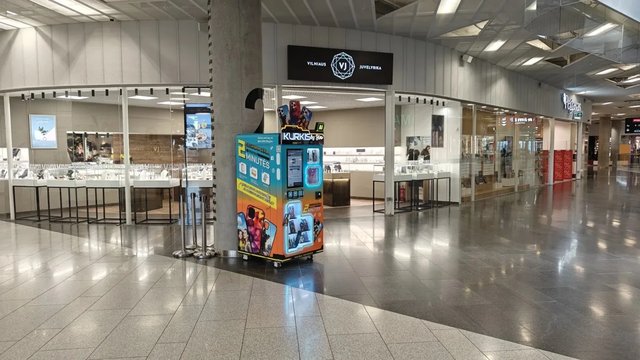
KURKIS by You prices its clear cases at €12.99–14.99 and its Premium Black MagSafe at €18.99; a 27%-46% premium for the magnetized version, selling side by side in the same Vilnius and Kaunas malls. In the U.S., Balaji Brands' kiosks print MagSafe and Qi2 cases exclusively, and MyCaseLabo ships MagSafe-ready as standard. The lesson: if your machine supports magnetic cases, sell them as a separate top tier. If it does not, factor that into which machine you buy.
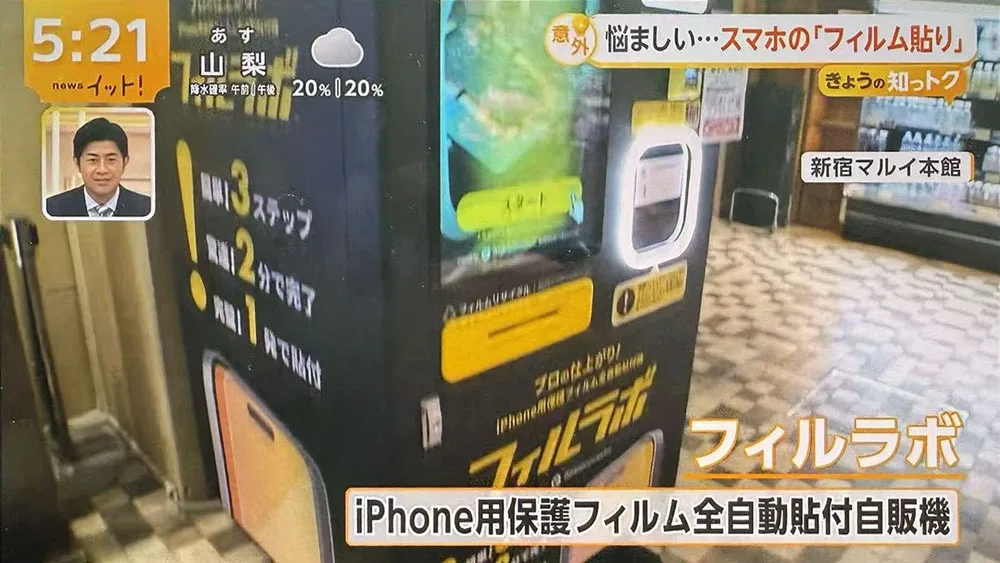
FilmLabo charges ¥2,980 for an auto-applied 9H glass film; identical to a custom case. CubeLab sells films and cases in the same A$19–29 band. In Malaysia, CASED's films at RM45–50 land within one dollar of its RM50 cases. The application service (automatic cleaning, bubble-free robot application in about 2 minutes) carries the value, not the raw material. If you price films as a cheap add-on, you are leaving the strongest margin in the business on the table.
€12.99, €12.90, ฿490, ¥2,980; every operator in the group prices just under a round number in local currency. This is not coincidence; it is the cheapest conversion-rate improvement available, and it costs nothing to copy.
CASED's RM50 (~$11) is the lowest price in the group; yet its kiosks sit in nine flagship Klang Valley malls and klia2 airport, the most expensive retail real estate in Malaysia, and it still funds a Creator Program that shares revenue with local designers. The lower price reflects a market-entry strategy with higher transaction volume, not a failure to hold price. VEGER's ฿490 (~$14) in Thailand sits in the same logic: accessible, but not cheap.
Set a price the market will pay
Get the machine specs and unit costs to back your pricing.
Request PricingBefore choosing a number, know the floor. From the same operator group:
Consumables: $3–$4 per case (blank case, ink); your largest variable cost
Venue share: 15–25% of gross sales in malls; revenue-share deals dominate
Payment processing: standard card rates; the top operators run fully cashless
Everything else (electricity, remote monitoring): negligible per unit
Run the floor math on the cheapest market in the group: a $11 case in Kuala Lumpur with $3.50 consumables and a 20% venue share ($2.20) still nets roughly $5.30 per sale; a 48% contribution margin at the lowest street price in the benchmark. At the $20 anchor with the same structure, contribution rises to about $12.50.
Floor price = consumables + venue share + payment fee, divided by your target contribution. If consumables are $3.50 and you will pay a 20% venue share, any price above $7 keeps every sale contribution-positive; but your floor for planning should be where per-unit contribution covers your fixed costs across expected volume, not merely where it is positive.
Using the table above, find your nearest comparable market. Western Europe supports €12.99–18.99. The U.S., Japan and Australia support the $20 / A$19–29 equivalent. Southeast Asia supports $11–14. Entering at the top of your local band is easier than climbing there later.
Every operator with a published range prices in tiers, and the structure repeats: an entry clear case, a premium MagSafe or Qi2 tier 30–45% higher, and films priced equal to cases. A representative three-tier build for a Western market: clear case at €12.99, custom design at €15.99, MagSafe at €18.99; copied almost directly from the KURKIS playbook. In the U.S. or Japan the same structure starts at $20 for the premium tier.
Hold full price in airports and flagship malls. Haneda T3, Kansai T2 and klia2 anchor three of the group's portfolios, and none of those operators discount. Captive, high-dwell locations buy at full price.
Raise when you add a tier, not when costs creep. The MagSafe premium (+46% at KURKIS) was created by adding a product tier, not by re-pricing the base case.
Bundle to lift average ticket, not to discount. Buy-one-get-one-50% style offers raise transaction value while protecting the headline price, as covered in our sales strategy guide.
Use guarantees to defend price. CubeLab's 30-day satisfaction guarantee on bubble-free film application is a pricing tool: it justifies A$19–29 against cheaper handset-shop fitting by removing the risk.
Behind every price on this page is the same unit economics. A GOBEAR kiosk prints a case for a few dollars of ink and a blank, so the spread between your street price and your cost stays with you. Its 20-plus-language interface and card, NAYAX, WeChat and Alipay rails mean the price you set works across markets without changing hardware.
Across 10 operators in 8 countries, the global band is $11–$21 equivalent, with most markets clustered at $13–$20 and $20 anchoring both Japan and the United States.
The one published comparison in the benchmark (KURKIS by You in Lithuania) prices MagSafe at €18.99 against €12.99–14.99 for clear cases, a 27%–46% premium. U.S. operators print MagSafe and Qi2 cases as their standard product at $20.
Some operators list automatic screen protector services at prices close to custom cases. These examples show that application convenience can support a separate service price. Profitability requires a separate calculation of film, application and maintenance costs.
Yes. The benchmark shows full price in airports and flagship malls across every market. A location-tiered approach (holding the standard band in premium locations and running bundles or entry tiers in secondary venues) matches how the strongest operators actually behave.
With consumables at $3–$4 and a 15–25% venue share, even the benchmark’s lowest price ($11 in Malaysia) holds a contribution margin near 50%. Anything below roughly $8–$9 starts squeezing the model in high-rent venues.
Share your business vision with us. Our automated retail experts will craft a tailored strategy and a comprehensive profitability report to unlock your next revenue stream.