Phone Case Kiosks in Airports: What 3 Airports Taught Us
Three airport phone case kiosk deployments and five lessons on terminal matching, pricing and partnerships.

I'm the COO of GOBEAR. We help entrepreneurs, mall operators, 3C mobile stores, event venues, and campus retailers tap into high-margin, low-maintenance vending models.
"How many machines should I start with?" is the first question every prospective operator asks; and the one most articles answer with a shrug ("start small and see"). This article answers it with three real companies that deliberately started at three different scales: PrintCase Express in Estonia began with 3 kiosks, CaseAutomaty in Poland runs 8, and Custom Case Kiosk (Balaji Brands) in the United States scaled to 50 within a year of launch.
These operators use GOBEAR phone case vending machines across three different markets. Their experiences with GOBEAR custom phone case and screen protector kiosks illustrate how fleet size affects location planning, maintenance needs and expansion options.
3 machines is a validation play: roughly €40,000 all-in territory, one flagship location per city, no staff, e-commerce bolted on for extra revenue.
8 machines is a market-ownership play: coverage of a whole country's major cities; and, in Poland's case, a platform to lease machines to other operators.
50 machines is a distribution play: it requires retail-chain partnerships and remote fleet management, and it is rarely a first business; it was Balaji Brands' second act after 19 years in U.S. retail.
Speed reference: the fastest single-brand scaler in the operator group, MyCaseLabo, went from national launch to 97 machines in about a year; through retail chains, not solo site-hunting.
|
Operator |
Start size |
Market |
Founded |
Price point |
What the size buys |
|
PrintCase Express |
3 kiosks |
🇪🇪 Estonia |
2024 |
from €12.90 |
one flagship mall in each of the 3 biggest cities |
|
CaseAutomaty |
8 kiosks |
🇵🇱 Poland |
; |
leasing from 5,000 zł/mo |
8 units across 8 cities + B2B leasing business |
|
Custom Case Kiosk (Balaji Brands) |
50 kiosks |
🇺🇸 USA |
Jan 2026 launch |
set by location |
21 states in year one, chain partners |
Note the founded dates: the 3-machine operator is two years old, the 8-machine operator built its country network methodically, and the 50-machine operator launched in January 2026 at CES. Starting size and company age are not the same variable; and the stories below show how each scale creates its own momentum.
Printcase EST OÜ, founded in 2024 with Latvian backing, placed exactly one kiosk in the flagship mall of each of Estonia's three largest cities: Ülemiste keskus in Tallinn, Tasku keskus in Tartu and Kaubamajakas in Parnu. Cases print from €12.90.
What makes this start smart is not the number; it is the placement logic. Three machines bought the best three retail addresses in the country, not six average ones. And the kiosks are not the whole business: an online custom designer with one-day production and free Baltic-wide parcel-locker delivery extends the same brand beyond the three physical points. The machine network validates demand and manufactures brand trust; the web store harvests it across three countries.
The closest variant in the operator group is KURKIS by You in Lithuania: two self-run kiosks in the flagship malls of Kaunas and Vilnius, plus franchise packages (€40,000–€60,000 for 3–5 machines, training and starting stock) sold on top. Two machines, deliberately world-class locations, and a licensing business layered over them.
The 3-machine playbook: buy the best addresses, not the most machines; add an online channel that shares the brand; treat every kiosk as a demand test for its whole city.
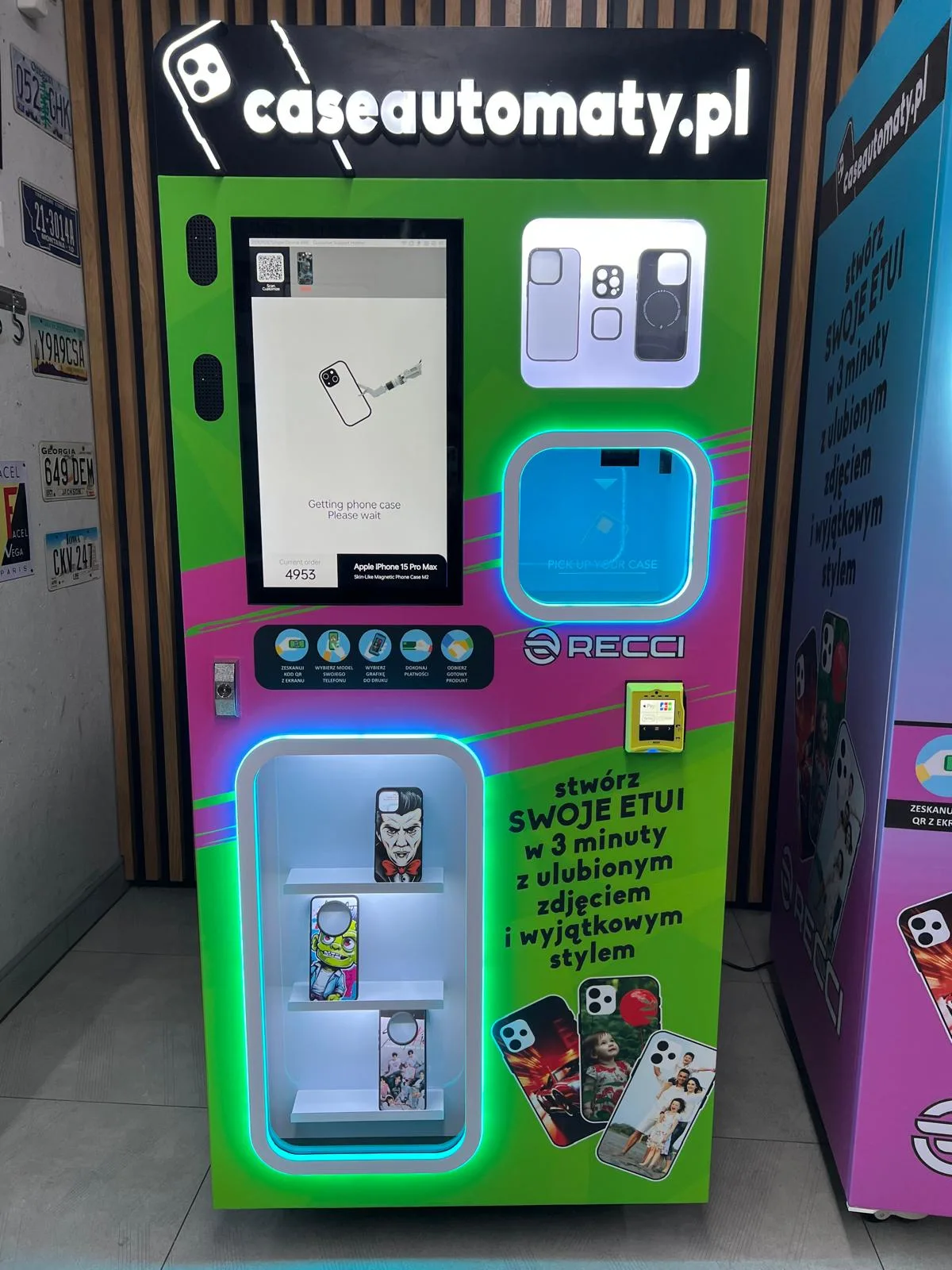
CaseAutomaty, GOBEAR’s local partner in Poland, reports 8 machines across 8 Polish cities, with its base in Pionki.
Alongside its own deployments, the company offers financing and support for other operators. Its published options include a one-month rental trial for 5,000 zł excluding VAT, with the payment credited toward purchase, and separate leasing terms of 24, 36 or 48 months. The trial price is not a confirmed monthly lease payment or a quotation for an eight-machine fleet. Support services include marketing, accounting assistance and remote technical support.
Its B2B materials also present a payback model of 2.5–5 months at 15 sales per day. This is an operator-published projection rather than verified profit data for its fleet.
The 8-machine playbook: A multi-city rollout requires funding and service arrangements for each location. Financing comparisons should account for machine quantity, monthly payments, total contract cost and the support included.
Custom Case Kiosk, a brand of Balaji Brands of Chino, California, launched at CES in January 2026. Within a year it had 50 kiosks live across 21 U.S. states (from Koreatown LA and Orange CA to Dallas TX, El Paso TX, Fargo ND and Humacao PR) with 6 more states coming, and picked up Best New Product at the 2026 International Bowl Expo.
The operating details matter as much as the count: kiosks print MagSafe and Qi2 cases in 3–5 minutes and are managed through a remote dashboard with over-the-air updates. Fifty machines across 21 states is only feasible with remote fleet management; there is no route-driving model that visits four time zones economically.
But the real enabler came before the machines. Balaji Brands was founded in 2006 and is present in more than 20,000 U.S. retail doors; its partners include Boost Mobile and SCHEELS. The 50-machine first year was built on two decades of retail relationships plus a CES launch that put the product in front of exactly those buyers. Starting at 50 is not a bigger version of starting at 3; it is a different business: distribution first, machines second.
The 50-machine playbook: sign chains, not spots; launch where your buyers already are; build for remote operations from day one.
The three stories bracket a spectrum, and the operator group fills the middle:
CubeLab (Australia) grew to 18 machines across three states (14 film kiosks and 4 case printers) by combining both product lines in suburban and regional malls, with a 30-day satisfaction guarantee.
CASED (Malaysia) runs 12+ kiosks across nine flagship Klang Valley malls and klia2 airport, adding a Creator Program that shares revenue with local designers.
VEGER (Thailand) is a different in-between: a Disney-licensed accessories manufacturer that built its own 20-kiosk brand in 2026 and now offers machines for rent or sale; starting big because it already had factories, supply chain and retail relationships.
MyCaseLabo (Japan) shows the ceiling: launched nationwide in June 2025 through partnerships with Don Quijote, Bic Camera and EDION, it reached 97 machines across 25+ prefectures in about a year; with sister brand FilmLabo at 86 more.
Notice what repeats across every scale: national retail chains and flagship malls, never mediocre secondary locations. Operators grow by repeating their best location type, not by averaging down.
Three questions decide it:
1. What can you fund without flinching? Three machines sit in roughly €40,000 territory all-in (the KURKIS franchise package prices 3–5 machines plus training and stock at €40,000–€60,000). Eight machines bought outright multiplies that; leased in Poland, the same fleet starts at 5,000 zł per month. Fifty machines is a seven-figure program; or a distribution partnership where someone else funds locations. For per-machine cost detail, see our cost and ROI breakdown.
2. What do you already own? Retail relationships, a factory, a brand, a sales team; anything on that list pushes you up the scale ladder. VEGER started at 20 because it was already a manufacturer; Balaji started at 50 because it already had 20,000 retail doors. If you own none of the above, 2–3 well-placed machines is not timid, it is correct.
3. Can you operate remotely? Remote dashboards and OTA updates make a 10-machine solo operation realistic and a 50-machine fleet economical. If your hardware cannot be monitored remotely, your practical ceiling is the distance you can drive in a day.
The common thread is the machine. A GOBEAR kiosk holds 770 cases in the K77 chassis and 1,140 in the K114, so your starting size is a choice about coverage, not about whether the hardware can keep up. Every kiosk ships with remote fleet management, so adding machines does not add a proportional operations burden.
Two to three machines in the best locations you can secure. Two of the 10 operators in this article run 2–3 machines profitably; placement quality predicts revenue far better than machine count.
The benchmark is Custom Case Kiosk in the U.S.: 50 kiosks across 21 states within one year of its CES launch; enabled by an existing retail distribution business, chain partnerships and remote fleet management. Without those assets, expect a stepwise path: 3, then 8–12, then up.
Not necessarily. Modern kiosks are managed through remote dashboards with OTA updates, and restocking runs on a 1–2 week cycle. CaseAutomaty supports its 8-city network (and its leasing customers) with 24/7 remote technical support rather than field teams.
Yes. CaseAutomaty in Poland leases kiosks from 5,000 zł (≈$1,300) per month on rent-to-own terms, bundled with marketing and accounting support, and VEGER in Thailand offers its machines for rent or sale. Leasing converts startup capital into operating cost and lets you scale faster per dollar.
Roughly €40,000–€60,000 all-in in Europe — the published KURKIS by You franchise package covering 3–5 machines, training and starting stock. Buying independently, budget $8,000–$15,000 per machine including shipping and first consumables.
Share your business vision with us. Our automated retail experts will craft a tailored strategy and a comprehensive profitability report to unlock your next revenue stream.